Adora Magic City International Cruise
Background
Adora Magic City is China’s first domestically built large cruise ship, built by CSSC and operated by Adora Cruises. Gross tonnage 135,500; capacity 5,246 passengers. Crew and staff from 30+ countries; over 60% non-Chinese. Job-oriented Chinese training for non-Chinese staff is essential for service quality and operations.
Project overview
Project: Adora Magic City Job Chinese Training for Non-Chinese Staff
Partners: Adora Cruises, Baizor International Chinese AI Lab
Target: Cabin, F&B, housekeeping, entertainment staff
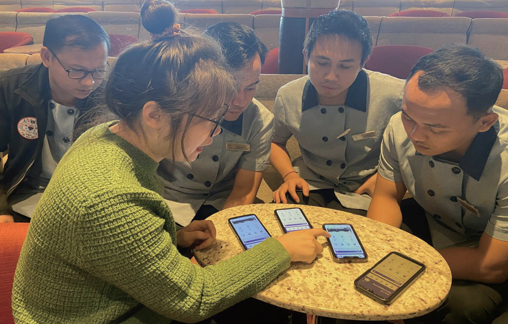
Setting: Shipboard mobile classroom, job Chinese training, service scenario simulation
Challenges
- Language barrier: Staff from Southeast Asia, Europe, South America lacked basic Chinese
- Job terminology: F&B, housekeeping, safety required specialized Chinese
- Complex scenarios: Diverse passenger needs and emergencies
- Limited training time: Short port stays made centralized training difficult
- Assessment: Traditional training lacked effective assessment
Solution
Baizor platform customized for job Chinese:
1. Scenario-based job Chinese courses — F&B (ordering, serving, complaints); housekeeping (check-in, cleaning, requests); safety (emergency broadcast, evacuation, medical); entertainment (introductions, games, culture).
2. AI assessment and pronunciation — Real-time speech assessment (fluency, completeness, accuracy, tone); automatic correction feedback; dialogue simulation for service scenarios.
3. Fragmented learning — Mobile platform; offline mode for unstable connectivity; 3–5 min micro-courses.
4. Management and assessment — Level-based assessment by job requirement; progress tracking; certificate upon passing.
Core technologies
- Speech recognition and assessment (multi-accent), NLP (dialogue generation), adaptive recommendation, multimodal teaching, offline sync
Results
- Improved Chinese: 80% of non-Chinese staff reached basic job Chinese in 3 months
- Better service: Passenger satisfaction up 25% after Chinese improvement
- Lower cost: 60% reduction in training time and cost vs. traditional
- Flexible learning: Fits fragmented time without affecting work schedule


Partner with us
If you want to introduce AI to improve Chinese teaching quality, contact us to explore collaboration.
Contact us